Thomas Pynchon likes to talk about Godzilla in his novels. In Inherent Vice, there is a funny scene where the main character Doc told his girlfriend Penny that the 1964 Japanese movie Ghidorah, the Three-Headed Monster was a remake of the 1953 romantic comedy Roman Holiday. Later that night, Doc caught Penny sobbing at the TV, because she watched the Japanese monster movie as a romance. Pynchon is good at writing this type of plot that is ridiculous but oddly touching. I watched the Ghidora movie after reading Inherent Vice. It is obviously nowhere near a remake of Roman Holiday (we are talking about a movie that is mostly about actors in rubber suits fighting other actors in rubber suits), but the writers must have lifted some plot elements from Roman Holiday.
I recently watched a Godzilla spin-off movie Rebirth of Mothra with my 4.5yo daughter, and I had a Pynchon moment. It’s a tragic scene where a comically giant moth caterpillar watched her mother, a giant moth, died and sunk into the ocean. It’s an unbelievably ridiculous scene featuring hilariously looking monsters. But it was genuinely touching. The filmmakers managed to tug a heart string with a giant moth and a caterpillar.
One music album that I used to play a lot of was called Night of Short Lives. It was published in the 90’s under the artist name Frame Cut Frame. It’s very hard to describe what kind of music it was. The publisher called it “unclassical music”, because the music had the classical texture, but not the classical form.
The CD was just one of those random things that I had. I don’t remember why I had it. I had no idea who made it or why it was made. It was published by an independent Belgian label called SubRosa so I had assumed that it’s European. But I just discovered it’s Australian! The music is by Brett Dean, with sampled sounds by Simon Hunt. Brett Dean turns out to be not just a random Aussie who made this obscure album. Wikipedia shows that he is one of the most celebrated Australian musicians!
2021-01-12
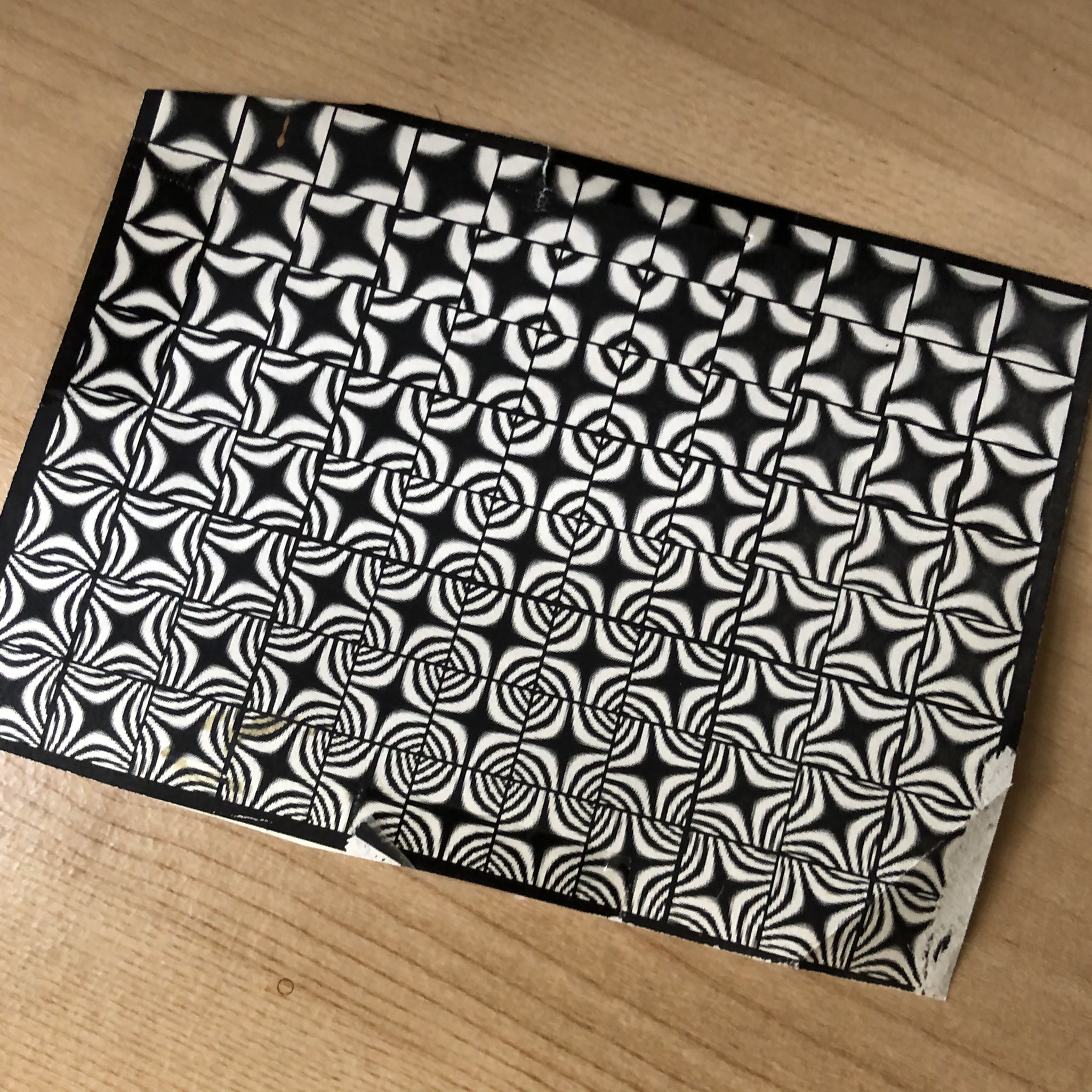
I found this in a box in the garage that hadn’t been opened in many years. I made it when I was a PhD student at UC San Diego. It’s a set of visual stimuli that I designed for a brain mapping experiment.
I have been reading Italo Calvino’s If on a winters night a traveller. One chapter is particularly interesting because it draws heavily on the imagery of optics (one of Calvino’s obsessions). It makes a reference to the 19th century British scientist David Brewster for his invention of the kaleidoscope. I hadn’t read about Brewster before so I had to look him up. He was so much more than the inventor of kaleidoscope. He was a major figure in 19th century optics, and made important discoveries about the polarisation of light.
This part of If on a winter’s night a traveller reminded me of Thomas Pynchon’s Against the Day, which also uses optics as a central metaphor. Interestingly, Against the Day makes references to Augustin Fresnel and Étienne-Louis Malus, but apparently not to Brewster.
I finished reading Thomas Pynchon’s novel V. about a month ago. I was thinking about writing a review, but what’s the point? Given its classic status, it has been analyzed to death. So just a couple of thoughts. This was Pynchon’s first novel, so we have to ask if it compares well to his later masterpieces. I think a novel worthy of Pynchon’s name must do two things: 1. It must induce a mindfuck. At some point, you must feel that this novel is 10x denser than what your brain can process. 2. There must be a couple of magic moments of sublime beauty. You must pause and say “Oh wow. That’s just beautiful. I have no words for it.” V. does both. Pynchon did it the first time. However, the novel does feel different. V. reads like it’s made up of several short stories. They are connected stories but you can detect the boundaries. No other Pynchon novel gave me that impression. The other thing is that V. is very cinematic. Many chapters end with dramatic scenes that I can visualize as climactic moments in epic movies. Later Pynchon novels are more organic, subtle, and abstract. This makes V. more accessible, but not lighter. I found reading V. a thoroughly satisfying experience. Many parts of it will stay with me for a very long time.
I was reading about the Emacs org-roam mode, and came across the Zettelkasten method of notetaking. I hadn’t seen this term before, but the idea of taking notes with cross-referenced index cards sounded familiar. Where did I read about it? Ah yes… in Umberto Eco’s Foucault’s Pendulum, the main character Casaubon (an ex-academic who makes a living as a “detective of knowledge”) uses boxes of index cards to keep track of ideas. I wouldn’t be surprised that Eco himself did this religiously. He apparently recommended it to PhD students.
Finished William Gibson’s Count Zero. I like William Gibson. There are things that he did extremely well in this novel. But it doesn’t work. The three main threads of narrative are all interesting ideas by themselves, but they don’t add up to a meaningful big picture. In the end, I don’t understand why anything happened. I was planning to read Mona Lisa Overdrive after this one, but maybe not. The second half of Count Zero seems too clumsily written for me.
I like this little episode in Umberto Eco’s Foucault’s Pendulum. In Chapter 53, one of the main characters Casaubon, a scholar of European history, unexpectedly ran into Inspector De Angelis in a library. He was surprised that the policeman checked out the same book that he was looking for. Why are you reading such an esoteric book? The policeman answered: “… when I’m off duty, I like to browse in libraries. It keeps me from turning into a robot, a mechanical cop”.
In V., Chapter 14, Pynchon made passing references to the Dreyfus Affair - a social controversy that divided France near the end of the 19th century. Just by coincidence, I read something about it earlier this year. The Father Brown story “The Duel of Dr Hirsch” by G.K. Chesterton is a very odd detective story, because it’s really a commentary on the Dreyfus Affairs.
The other historical figure that plays a more significant role in V. is Charles Gordon - the British military officer who was killed in the Siege of Khartoum in 1885. Some of the characters in the novel might have encountered Sherlock Holmes because according to The Adventure of the Empty House, Holmes visited Khartoum after The Final Problem (1891)! In The Adventure of the Cardboard Box, it was revealed that Dr. Watson had a portrait of Charles Gordon in his house.
Idea: a Python dialect called Pynchon (after Thomas Pynchon). A pynchonic code is probably not very pythonic. Brevity is highly discouraged. Variable names should be all puns. In fact, Pynchon should be a concatenative language like Forth. This way, statements can be chained together into a longer and longer statement… until the entire program is one single statement.
An obscure historical note from Thomas Pyhcon’s novel V.: there is a Chopin museum in the Spanish island of Mallorca, where you can see a cast of Frédéric Chopin’s hand. Chopin spent a winter there in 1838.
I know that overgeneralisation is a controversial topic in the study of language acquisition, but here is an example: Zoe (4yo) used to say “even better”, but recently she started to say “even gooder”.
An interesting topic I studied in an animal behaviour class was about the concept of culture in animal societies. I started to think about the transmission of culture recently because I noticed that my 4yo daughter Zoe’s childcare playgroup has developed their own culture. When Zoe started to use a new word, I used to assumed that she learned it from the childcare educators. But recently I noticed that the children are teaching each other. For example, Zoe referred to her gym teacher as “torch Aaron” or “toch Aaron” instead of “coach Aaron”. I thought it was her own coinage until I heard other children talking about “toch Aaron”.
Another example is using the word “phew” as a verb. She said “I was playing with Esther and then Samantha came to phew us.” What’s phew? She said it was going “phew phew phew!” Clearly it’s the children’s own word.
Watching these children using their own words was like scientists observing monkeys learn to wash potatoes from each other.