Umberto Eco’s novel The Name of the Rose opens with a Preface, in which Eco claimed that the novel was his translation of a 14th century manuscript written by a monk named Adso. Eco wrote that despite years of research, he failed to establish the authenticity of the manuscript. However, he found vague references to Adso’s manuscript in several obscure places.
One of the books he encountered in his investigations was a “Castilian version of a little work by Milo Temesvar, On the Use of Mirrors in the Game of Chess.” This Preface is clearly an homage to Jorge Luis Borges and Don Quixote. On the Use of Mirrors in the Game of Chess is an evocative title for a fake book. What can this book possibly be about?
Interestingly, people have invented chess variants involving mirrors (metaphorical ones, of course). For example, in a chess variant called House of Mirrors Chess, a physical chess piece can project mirror images on the board, and these virtual pieces can be captured by the opponents virtual or physical pieces.
According to a certain AI service, the 1900 Paris Expo (i.e. Exposition Universelle) featured gamelans from Surakarta (central Java) and Bali. That sounded very unlikely, because the first Balinese gamelan performance in Europe, I read, was by Gunung Sari of Peliatan in the 1931 Paris Colonial Exposition. Where did the AI get the idea from? One possibility is that Judith Gautier, the 19th century Parisian writer, wrote that the gamelan musicians who graced the 1900 Paris Expo were from “Solo, Bali”. That was clearly an error, but now it might find its way into someone’s homework. Interestingly, that performance was attended by Olivier Messiaen.
I love this lecture by UCSD’s music professor Steven Schick about percussion music. He said that in music, the suffix ist is focused on the object that is played. For example, in the word pianist, the focus is on the piano. The term percussionis, however, is not centered on an instrument. Rather, it is centered on what the musician does. The German word for percussion schlagzeug defines the music perfectly: schlag means to “strike” and zeug means “stuff”. That’s what percussionists do: they strike stuff.
Interestingly I recently the word gamelan also refers to an action. The word is derived from the Javanese word gamel, which means “to handle”. The same word also refers to a type of hammer. So the word gamelan is also related to the act of hitting the instrument with a mallet.
Why so much interest in the longitude in the 1990’s?
The Island of the Day Before (Umberto Eco, 1994): A novel set in the middle 17th century, when European started to tackle the problem of measuring longitude at sea.
Longitude (Dava Sobel, 1995): A non-fictional book about the history of the longitude problem.
Mason & Dixon (Thomas Pynchon, 1997): A novel with numerous references to the longitude problem, set at a time when the problem was just solved (about 100 years after Eco’s novel)
In Tlön, Uqbar, Orbis Tertius, Borges discovered an important clue about the secrets of Tlön when he found a letter hidden in a book:
In March of 1941, a handwritten letter from Gunnar Erfjord was discovered in a book by Hinton that had belonged to Herbert Ashe.
Gunnar Erfjord and Herber Ashe are both fictional characters who are members of the Orbis Tertius secret society, but who is Hinton? Hinton is mentioned only once in the entire story, so he must be a historical figure. But which Hiton is so famous that he could be referred to just by the last name?
Interestingly, it is the mathematician Charles Howard Hintin, whose fictional and non-fictional writings had inspired the public’s interest in the fourth dimension. He was name-checked in two other stories by Borges (The Secret Miracle and There Are More Things), and was mentioned by H.P. Lovecraft and Aleister Crowley.
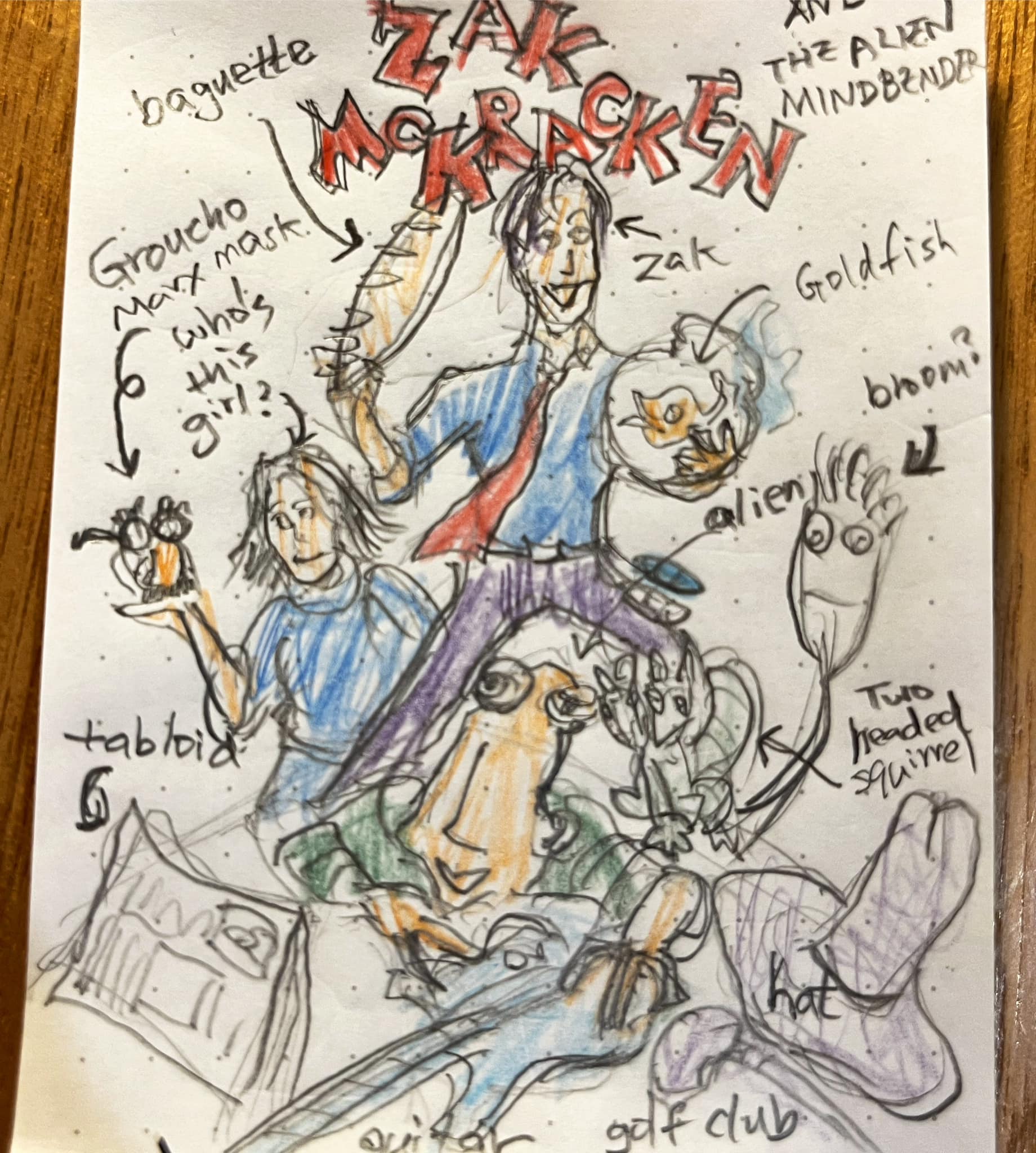
A tribute to Zak McKracken and the Alien Mindbenders, an old adventure game. The game has the greatest cover art ever. I haven’t played the game myself, but what could the plot be? Zak McKracken, a tabloid journalist is holding a baguette and a fishbowl, standing on a pile of fallen alien guitarists in cowboy hats. There is a broom with a face, a two-headed squirrel, and a girl holding a Groucho-Marx mask. Somebody should turn it into a children’s book.
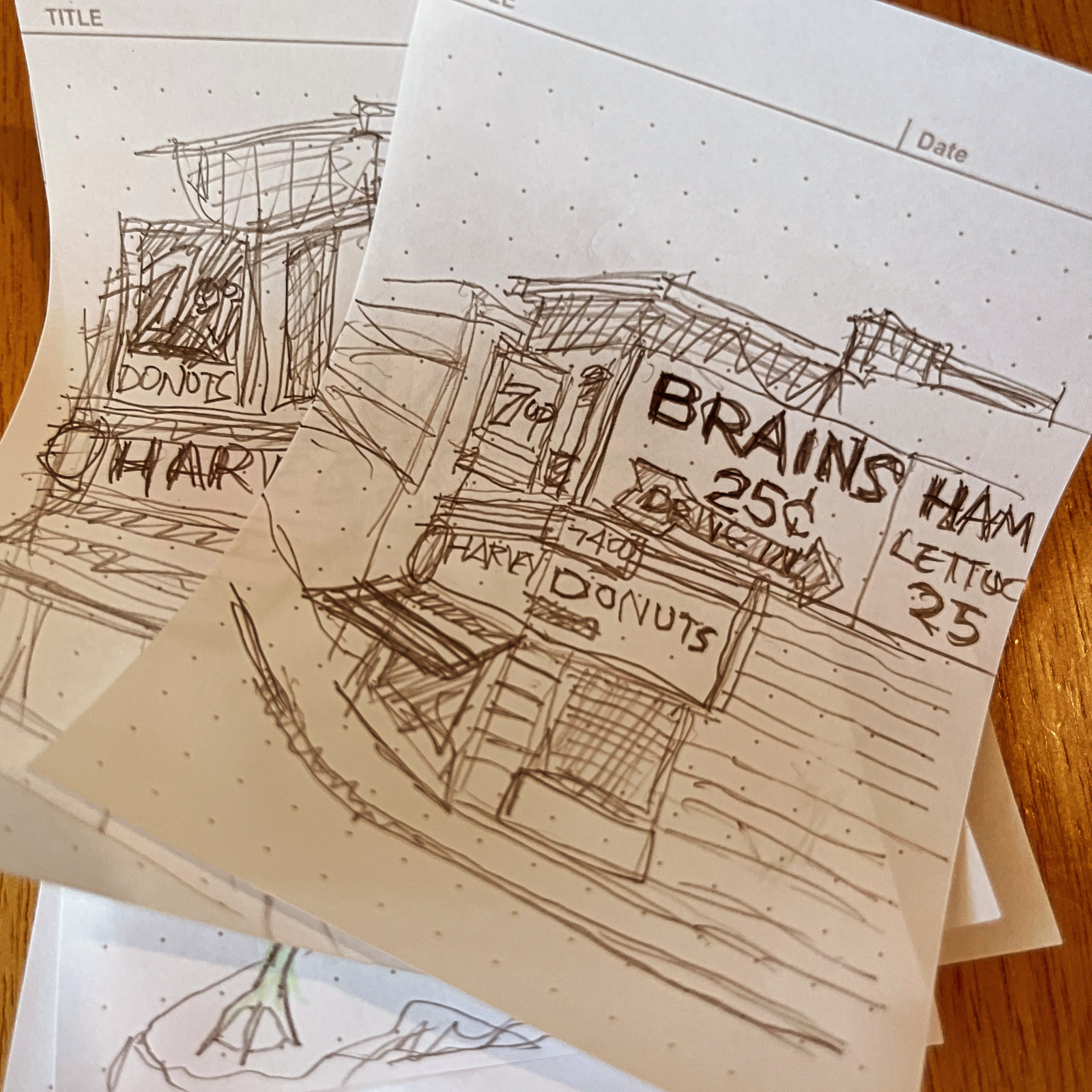
A friend shared with me a photo of a sign that says “Brains 25c Drive In”. It’s on the cover of the Bill Frisell album Where in the World? (1991), and many other places. It was a real sign advertising a fried brain sandwich, found in St. Louis, Misouri in the 70’s and 80’s.
Guitar learning diary: As I learn to play the guitar, I realised that I might be able to make musical associations without mental awareness. It’s probably because I am not familiar enough with the language of music to surface musical feelings to a conscious level. For example, yesterday, I tried to play some dominant 9 chords in a book. I was learning the fingering so I wasn’t attending to the sounds of the chords. It’s all mechanical at this stage. If you ask me to imagine a C9 chord, I wouldn’t be able to do it. I don’t know how to use a 9 chord in a musical context.
However, today, when I listened to the My Buffalo Girl track on Bill Frisell’s Good Dog, Happy Man album, I noticed that he played an interesting chord that sounded dissonant but musical at the same time. I looked it up in the Bill Frisell: An Anthology songbook, and what do you know? It’s a dominant 9 chord!
This happened to me before. I was interested in Miles Davis’ So What, so I tried to play a couple of bars of Miles’ solo. It was mostly an exercise to learn the Dorian mode. Then, for no apparent reason, I thought about Bill Frisell’s Monroe (again, from the Good Dog, Happy Man album) and tried to play it. It took me a while to discover that Monroe is in Dorian mode!
I am not sure if these are all coincidental, but I suspect that an interesting psychological phenomenon is in the play.
One of the zanier moments in Penn & Teller Fool Us: While Penn used a magic trick to comment on the New Testament (in which Teller was both the camel and the rich man at the same time), he said that heaven to him was listening to Sun Ra playing Bob Dylan tunes, while eating vegan fudge and watching the Tree Stooges chasing a honey badger on TV.
I had a surreal experience reading Steve Jobs and the NeXT Big Thing by Randall Stross, published in 1993 (I found a copy for free). Stross argued convincingly that NeXT was hopeless. Had I read it in 1993, I would have thought that the analysis was spot on. Who would have thought that in 2023, people would be still using essentially NEXTSTEP? Also, the entire workstation market has been wiped out, but IBM is still selling mainframes!
My family has been watching the Penn & Teller: Fool Us TV series. I was reminded of a 2008 paper published in Nature Review Neuroscience about the psychological aspects of magic. Teller was listed as a co-author (among several well-known magicians). There is a very remarkable sentence in the paper: “One of the authors of this Perspective (referring to Apollo Robbins) is a professional thief.”
Some friends and I ran into a trivia question about an ice cream named after Jerry Garcia of the Grateful Dead. A friend said that it must be a pun, so I suggested “Grapeful Dead”. The answer, of course, was “Cherry Garcia”.
It took me a while to figure out why I like Bob Dylan’s Subterranean Homesick Blues music video. It’s because I like watching the words falling down one by one.